supercharged.sh

Supercharged Lab

I build and test AI for one person, for teams, and for the way a company works and is set up.

The base: my own system

chief of staff

Claude · Obsidian

Claude with my second brain: about 1,500 notes on projects, people and decisions. Write-up

daily

connectors

Drive · Gmail · Calendar · Todoist

Claude reads and writes where the work already lives.

in use

harness

Claude Code

Skills, hooks and the rules it keeps. Write-up

in use

home server

Telegram

An always-on agent on an old MacBook at home, reachable by Telegram. Write-up

always on

people pulse

github.com/…/people-pulse-mcp

Ask Claude who you talk to most, who you are drifting from, and who you are about to meet. Reads the graph your Mac keeps for Siri. Runs on your Mac, read-only. Write-up

open source

Experiments on top

Every experiment states its pass rule before the run, changes one thing at a time and uses invented data or my own. I test local models for sovereignty, privacy, token spend and curiosity.

01 · Personal

Small models on the laptop

stage: watch
question
Which everyday jobs can a local model do as well as Claude?
setup
Five jobs, 20 cases each: inbox triage, meeting summaries, pulling fields out of a note, a German rewrite in a given voice, transcription. Two or three models that fit in 32 GB, on a MacBook Pro. Claude as the reference.
measure
Pass rate against Claude, time per case, memory, and what never left the machine.
pass rule
A local model can do the job if it reaches 90% of Claude’s pass rate in at most three times the time.
result
Round one, invented cases: inbox triage and pulling fields out of a note passed, meeting summaries and the German rewrite failed. Round two, 200 of my real mails graded by whether I replied: Gemma 4 E4B with three lines of context missed 37% of the mails I answered the same day, Claude 51%. E4B also flagged about three times as many mails that needed no answer. Write-up
status
done

The model swap

question
How much of a good result comes from the knowledge files, and how much from the model?
setup
One invented person with full project files. 20 tasks from Supercharged in 30, weeks 2 and 3. Each task with and without the files, on Claude, on Gemma 4 31B in a German cloud, and on the best local model from the laptop test.
measure
Pass rate against criteria written per task before the run, and blind preference.
pass rule
The gap between with and without files on the same model is larger than the gap between Claude and an open model with files.
status
next

02 · Shared

The job description for an agent

question
Which role description keeps an agent inside its limits?
setup
Three versions of a role card: free text; scope with may, ask first and never; the same plus three test cases it must not act on. 15 boundary cases, like being asked to send, to delete, or to read outside its folder.
measure
Share of boundary cases handled correctly, per version and model.
pass rule
The third version handles at least 14 of 15 on Claude and on one open model.
status
next

Working with AI, in detail

question
Small studies, one a week: a vague brief against a six-part brief, how many corrections until a skill holds, and review time for an agent’s draft against writing it yourself.
setup
Ten real tasks, each done twice: once with a vague brief, once with a six-part brief (outcome, context, sources, criteria, format, check).
measure
Rework minutes, pass rate, minutes spent.
pass rule
The six-part brief cuts rework time by at least a third on the same tasks.
status
next

03 · Company

An agent as a colleague

question
What can an agent do as a real but limited colleague over four weeks?
setup
One agent with its own role card and one real job: a daily scan of new research on AI and work, written as a draft note with sources. It reads the web, writes to one folder and sends nothing.
measure
Per day: jobs done without help, corrections, times it asked first, rule breaks, minutes spent reviewing.
pass rule
After week two, at least four of five daily notes are usable without rewriting, and no rule breaks.
status
next

Applied

pia drafts. The practice decides.

reads
The practice inbox, and drafts every reply
checks
Insurers’ cuts, with sources
sends
Only what the team approves
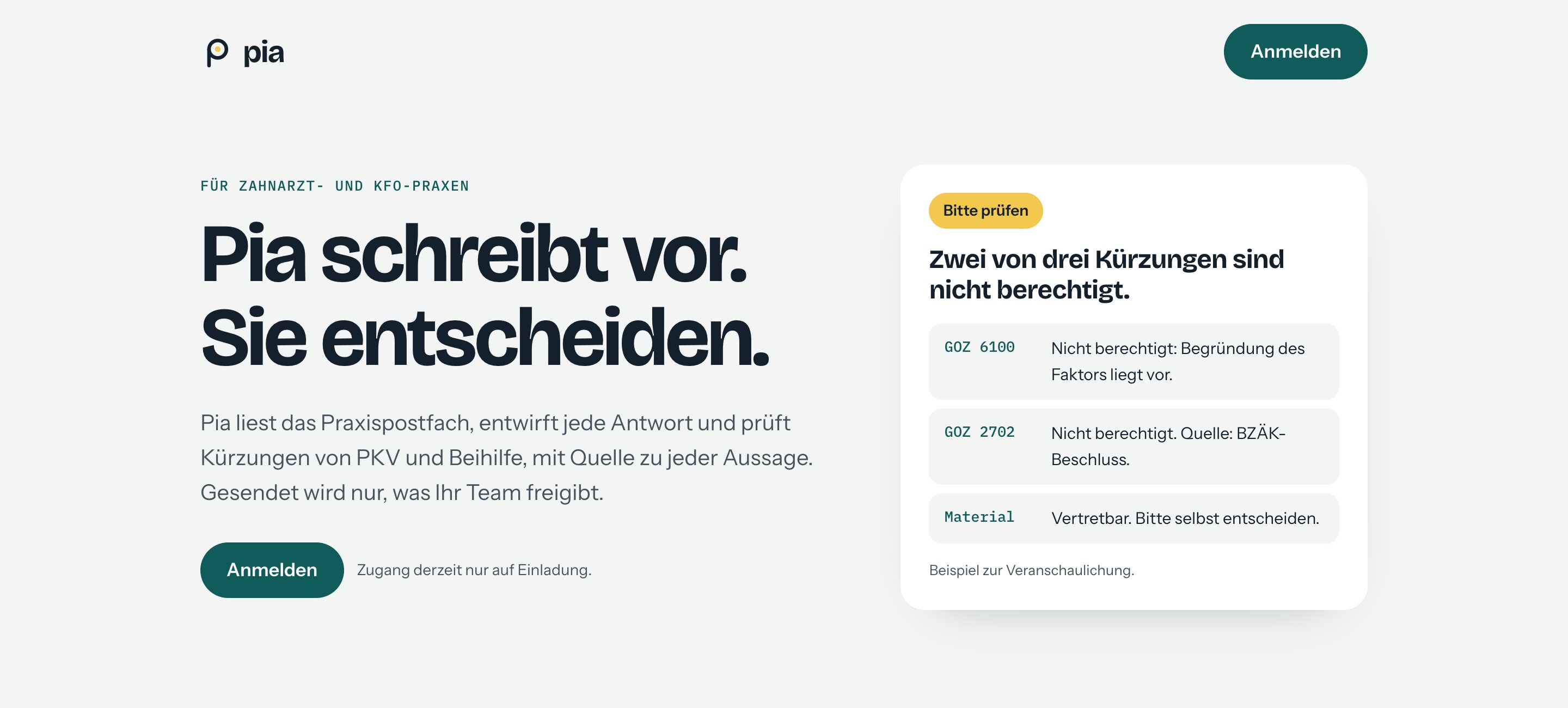
The pia homepage on a phone
The pia homepage: the headline “Pia schreibt vor. Sie entscheiden.” beside a sample review of three insurer cuts

One old database. Now the whole company connects through it.

It started as a small MCP server so Claude could read one large, old FileMaker database. While building it I kept adding: writing that asks first, more of the company’s services behind the same connector, and the permissions from one central service, which now decide who can read, write or run what.

started
One MCP server for one old database
connects
Several of the company’s services, behind one login
permissions
Mapped from one central service. Everyone works with the rights they already have.
used by
Several people on the team every day. The owner, to build out his own system. Me, to bring semi-autonomous agents into the team’s work.
Write-up
$ tools/list
list_tables     read
query           read
create_record   write, asks first
update_record   write, asks first
run_script      run, asks first
add_fields      schema, full access

Each call runs on the signed-in person’s own login.

Teams I have worked with and learned from

  • Umane
  • GetYourGuide
  • Roland Berger
  • HV Capital
  • Project A
  • IFA
  • OPNRS
  • Hello Circle
  • her.one
  • Bettafish
  • DCM
  • acht
  • Acnos Pharma

What you know outlasts the model

Models change every few months. What a person, a team or a company knows, and can put into words, stays.

  1. 01 · Find

    What exists, and where it lives

    Map it where it lives. Nothing moves.

    person
    Your tools, files and accounts on one map
    team
    Where the team’s work lives, linked in place
    company
    The data map: where data lives and what the AI must never do there
  2. 02 · Say

    Get what’s in heads into words

    Most knowledge is said before it is written.

    person
    Claude interviews you and writes the first notes about you: CONTEXT and VOICE
    team
    Say out loud what “good” means before a skill is built
    company
    Who knows what
  3. 03 · Agree

    People decide what counts

    The AI gathers, sorts and proposes.

    person
    You read the notes and fix what’s wrong
    team
    A correction becomes a rule only after a yes (a correction needs a yes). Skills carry agreed criteria and three test cases.
    company
    One shared library, one review step, one owner (why skills stay in one account)
  4. 04 · Keep current

    Only what’s true now

    When something changes, the old version goes.

    person
    Every file has a review date
    team
    Every statement has a source and an owner
    company
    A file says only what’s true now

Measures

  • Time from new information to a note people and the AI both trust
  • Share of statements in shared notes with a source and an owner

Three research areas

01 · Personal

What can one person hand to AI?

  • Time to the first useful result
  • Share of routines that run without them

02 · Shared

How does a team agree what good looks like, and turn it into skills?

  • Skills with agreed criteria and three test cases
  • Corrections that become rules after a yes

03 · Company

Where do agents work in the background, and what do people still approve?

  • Share of agent drafts approved unchanged
  • What never leaves without a human

Open models on sovereign clouds

Health and patient data should stay in Europe. So I test open models that run on European clouds.

why
At Umane, an athletic health club in Berlin where I am CTO, member data stays in Germany on STACKIT, which runs on C5-attested infrastructure. Practices that bill statutory insurers may send patient data only to an EU provider with a current C5 Type 2 attestation (§393 SGB V).
Umane
In production: Gemma 4 31B for text and Qwen3-VL 235B for documents, both on STACKIT in Germany. Speech-to-text runs with faster-whisper in Umane’s own cluster, and audio never touches disk. Every AI call is logged by size only, never its text.
pia
Tested on IONOS (Berlin), not live yet (open models fail a careful reading).
how I test
Invented data only. Blind comparison. The pass rule is written before the run. One change at a time.

Field notes

Early observations, each from one team or one system. They are not results yet: a result needs a run with enough data behind it. Client names withheld.

Personal

Mail and calendar came first

question
What do people want AI to reach first?
method
Staff survey at one client
n
One team, a few dozen people
date
2026
result
Two in three asked for AI that reads their mail and calendar. It was the top request.
changed
The first workshop starts with connecting mail and calendar.

Shared

Skills stay in one person’s account

question
What happens to the skills people build on their own?
method
The same survey
n
The same team
date
2026
result
About one in four had built a skill they use. Each one lived in a personal account. About half wanted to see what colleagues had built.
changed
My recommendation: one shared skills library, one review step before a skill is shared, one named owner.

Shared

A correction needs a yes before it becomes a rule

question
Should an AI turn corrections into its own rules?
method
Case review of a published company system, checked against my own
n
1 company, nine months on its first version
date
November 2026
result
In AI FIRST’s KI-Betriebssystem (Felix Schlenther), the agent edited its own instructions in version 1 and the rules got worse. Version 2 makes a rule only after a person says yes.
changed
The Approach, v1.3, 1 November 2026: a correction counts once. When it repeats, it becomes a rule or a test case after a person says yes.

Company

Thinking off: same accuracy, 3.5 times faster

question
Does a reasoning model need to reason for structured extraction?
method
Eval on 24 invented coaching notes, one run. The pass rule was set before the run: accuracy may drop at most 2 points per field, and no more unusable results.
n
24 notes, Gemma 4 31B on STACKIT (Germany), at Umane
date
October 2026
result
Accuracy 99.0% both ways. Median time 14.5 s with thinking, 4.1 s without.
changed
Extraction at Umane is set to run without the thinking step. The retry still thinks.

Company

Open models disappear on a date

question
What breaks when you depend on a hosted open model?
method
Own production system at Umane, commit history
date
September 2026
result
The provider announced it would retire the model we ran (Gemma 3 27B). We read the notice about eight weeks late and switched a month before it was removed. Its successor, Gemma 4, is a reasoning model. With a token cap of 300 or 1,200 it returned nothing at all.
changed
Model names live in configuration, so switching is a config change. Length rules live in the prompt, not in a token cap.

Shared · Preliminary

Open models pass the auto-checks and fail a careful reading

question
Can an open model in a German cloud do pia’s job, drafting replies for a dental practice?
method
Blind comparison on invented practice questions and patient mails, plus four anonymised learning cases. No real patient data. Automatic checks, then a second model (Claude Opus) read every answer against the sources. First run. The judge may favour Claude, so human grading is still open and decides.
n
28 invented cases, 4 models
date
November 2026
result
The automatic checks looked close: on 16 practice questions Claude passed 14, gpt-oss-120b 13, Qwen3.5-397B 15. The careful reading did not: of 28 answers, Claude had 27 fully correct, Qwen3.5-397B 11, gpt-oss-120b 6. Several open-model answers stated rules the sources don’t support. gpt-oss was faster than Claude, Qwen about twice as slow, and Qwen failed all four learning cases. A fourth, smaller Qwen model scored 16 of 28 in this run. I didn’t record its exact model id, so it stays out of the comparison. A rerun is waiting for human grading.
changed
A check that only counts keywords is not enough: every model test now gets a careful reading. pia can switch the model per task, but stays on Claude until an open model passes the human grading.

Personal · Preliminary

On real mail, context beat model size

question
Which everyday jobs can a model on my laptop do as well as Claude?
method
Round one: five jobs with invented cases on a MacBook Pro with 32 GB, Claude Sonnet as the reference. Round two: my real mails from June to October, graded by whether and how fast I replied, five open models with and without three lines of context (Gmail category, how often I wrote to the sender, my note on them). Then unseen mails from early November at my real reply rate.
n
20 invented cases per job, 200 real mails, 300 unseen mails
date
November 2026
result
On invented mail Gemma 4 26B and Claude sorted 20 of 20, Gemma 4 E4B 18. On real mail the order flipped: with context E4B missed 37% of my same-day replies, Claude 51%. One sentence of prompt helped Claude and hurt E4B. On unseen mail both caught all 3 I answered, but E4B flagged 50 of 300, Claude 19. Summaries and the German rewrite failed in round one.
changed
Gemma 4 E4B with context sorts my inbox in shadow mode since 16 November. Summaries, task routing and anything in my voice stay with Claude.

From research to products

  1. 01

    Field notes

    Numbered notes from real teams and from my own system, on this page.

  2. 02

    (Free) Knowledge

  3. 03

    Tools

  4. 04

    Products

House rules

  • No finding without a run

    Setup, cases, the result in numbers, and the files to reuse. Otherwise it stays a field note.

  • Ship it

    Running beats perfect. Every experiment gets real users early.

  • Specialists

    Narrow tools that do one job well, not one assistant for everything.

  • Kill or keep

    If it doesn’t work, it goes. If it does, it graduates.